



Flat pattern, bend allowance and K-factor
钣金展开与K因子
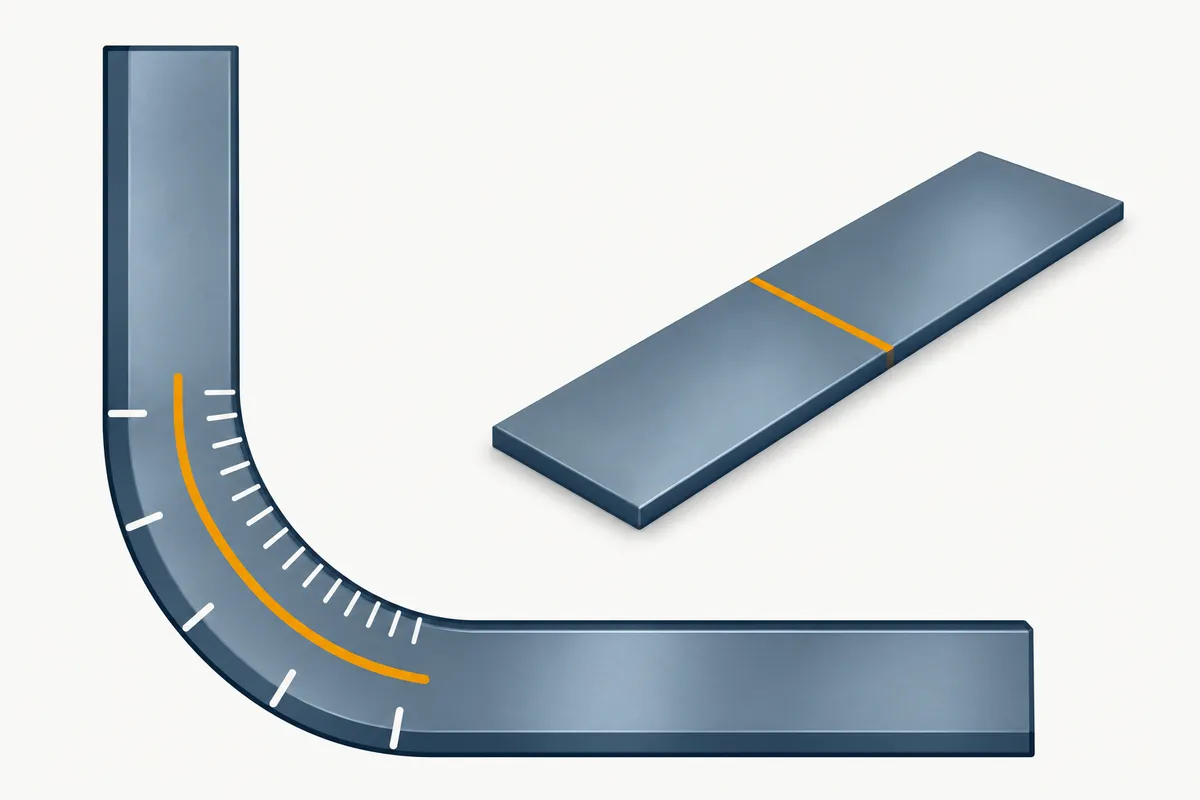
In plain words
When you fold a sheet, the outside of the bend stretches and the inside gets squashed. To cut the flat piece the right size you have to work out its length before folding, using a rule (the K-factor) for where inside the sheet the metal neither stretches nor squashes.
What it is
A bent part is cut flat first, so its flat length has to be worked out. In a bend the outside stretches and the inside is squeezed; one line in between, the neutral axis, keeps its length. It sits a fraction K of the thickness in from the inside surface, typically 0.3 to 0.5. The length of the neutral axis through a bend is the bend allowance, BA = angle in radians × (R + K·t), where R is the inside bend radius and t the sheet thickness, and the flat length is the sum of the straight lengths plus one bend allowance for each bend. Shops refine K, or tabulate the bend deduction directly, from test bends with their own material and tools. CAD sheet metal tools unfold the 3D model into the flat pattern that gets cut.
Why it matters for products
The flat pattern gives the sheet area, cut length and nesting, so unfolding the model correctly is the first step of every sheet metal quote; a wrong K puts every flange off by a fraction of a millimetre per bend.
Learn first
Making a part like this? Plan the process and estimate costs in Workspace.