



Annealing, normalizing, quenching and tempering
退火、正火、淬火与回火
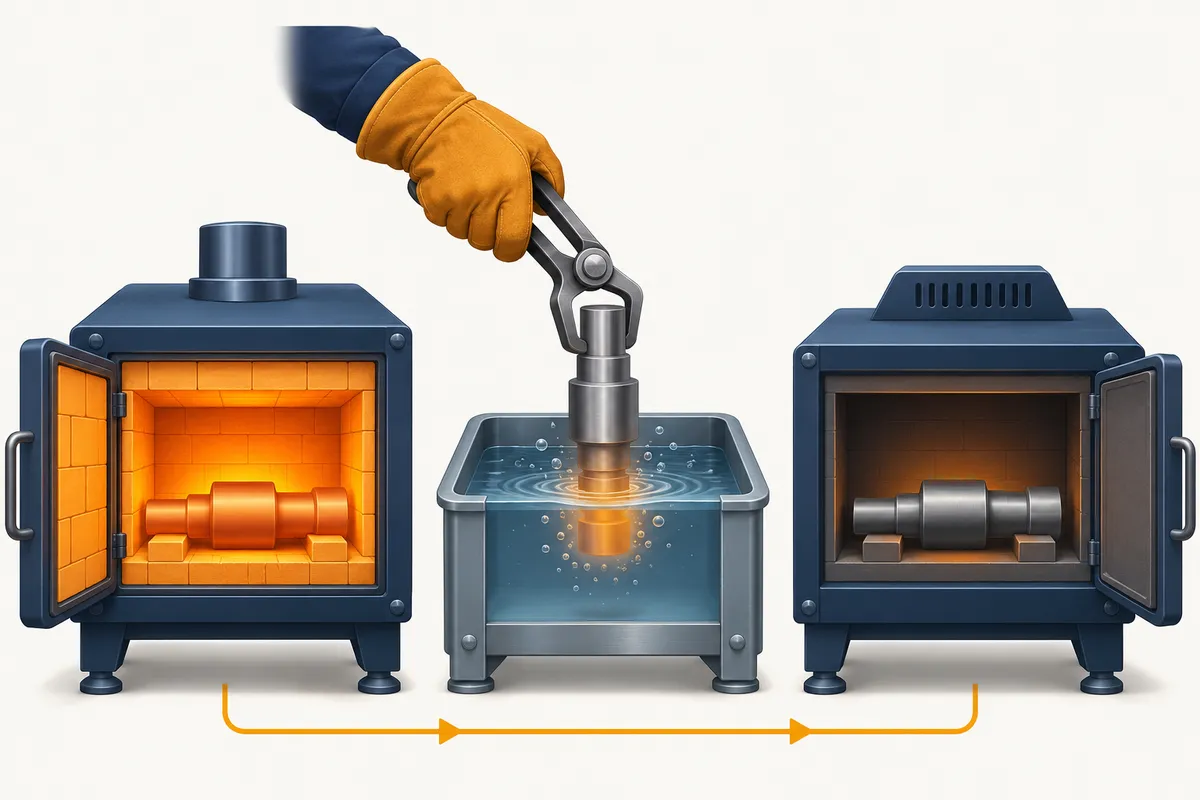
In plain words
Steel changes character with heat, as a blacksmith knows. Heated red and cooled slowly it turns soft and easy to cut; plunged hot into water or oil it turns very hard but brittle, like glass; warmed again afterwards it becomes tough. Picking the right recipe, and when to do it between the cuts, is part of planning a steel part.
What it is
Four basic treatments (四把火) change the whole of a steel part, not only its skin (161). Full annealing (退火) heats the steel above its critical temperature and cools it slowly in the furnace, leaving it soft and easy to cut. Normalizing (正火) cools it in still air for a finer, more even grain; forgings and castings are often annealed or normalized before roughing. Quenching (淬火) heats it the same way and then plunges it into water, oil or polymer, making it hard but brittle, and tempering (回火) reheats it to trade some hardness for toughness. Quenching with a low temper keeps tools and wear parts hard. Quenching with a high temper is 调质 (quench and temper), the usual treatment for shafts and gears in 45 or 40Cr steel, typically to about 220 to 280 HB. Quenching distorts parts, steel held hot in air grows scale, and thick sections of plain carbon steel do not harden all the way through.
Why it matters for products
调质 usually sits between roughing and semi-finishing, and through hardening sits before grinding; each is usually an outside step priced by weight, with a distortion allowance (180), often straightening (166) and a hardness check (169).
Learn first
Opens the way to
Making a part like this? Plan the process and estimate costs in Workspace.