



Wire EDM
线切割
In plain words
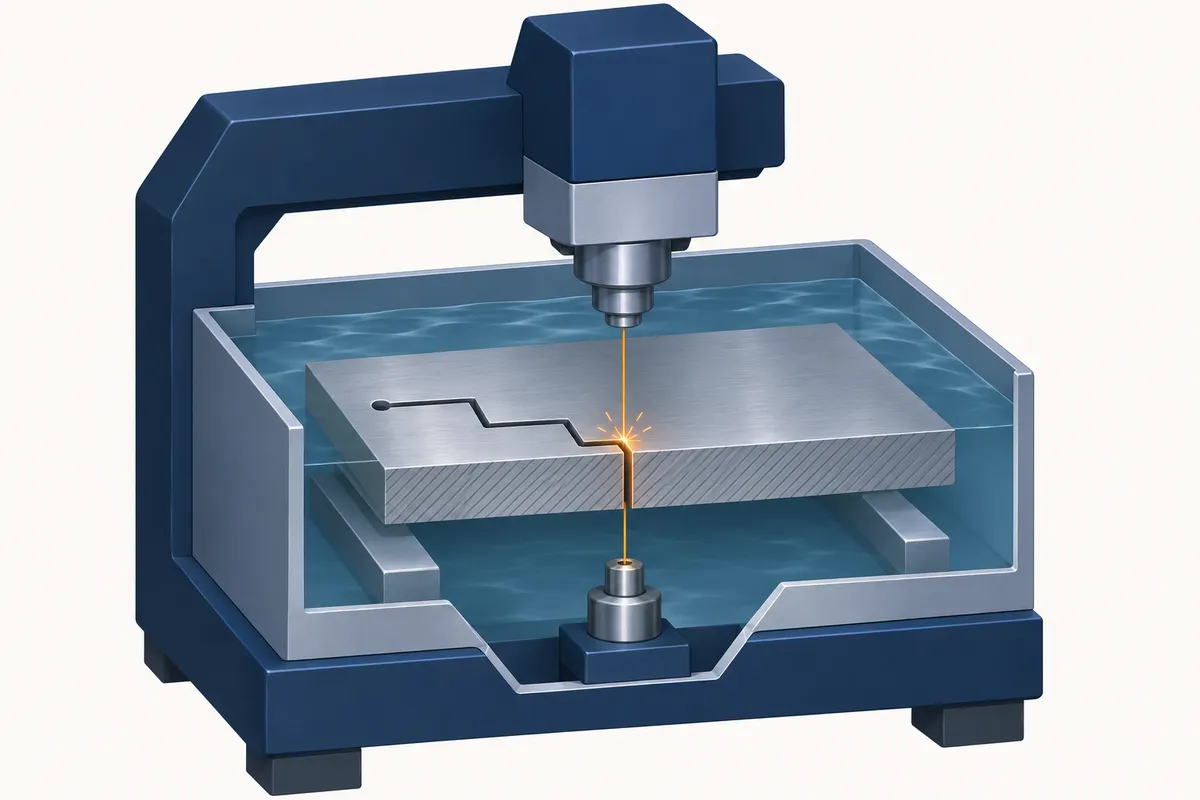
A very thin wire, thinner than a guitar string, works like a cheese wire made of sparks. It never touches the metal: sparks jump a tiny gap and eat a narrow slot along the drawn outline, straight through plates of any hardness.
What it is
A thin wire, usually brass and 0.1 to 0.3 mm across, runs between an upper and a lower guide and cuts a through profile in any conductive material, however hard. It never touches the part: sparks jump the small gap and erode a slot only a little wider than the wire, while water flushes the debris away. The program moves the wire offset by its radius plus the spark gap, so inside corners can be as small as about 0.1 mm in radius with a fine wire. Tilting the guides cuts tapers, such as the clearance behind a die opening. A closed inside profile needs a start hole first. One cut leaves a matt, slightly rough surface; one or more skim cuts at lower power bring the size within a few micrometres and the finish much finer. Chinese shops speak of 快走丝 (fast reciprocating molybdenum wire, reused, cheap and rougher), 中走丝 (the same machine with skim cuts) and 慢走丝 (brass wire used once, precise and costlier). Speed is cut area per minute, cut length times thickness, so a thick plate cuts slowly.
Why it matters for products
Time is cut area divided by the cutting rate for each pass, plus threading the wire and drilling start holes; many Chinese shops price wire work by cut area, and it is the standard answer for punch and die profiles, keyways, slots and sharp internal corners in hardened steel.
Learn first
Making a part like this? Plan the process and estimate costs in Workspace.