



PVD, thermal spray and other coatings
PVD、热喷涂、热浸锌与达克罗
In plain words
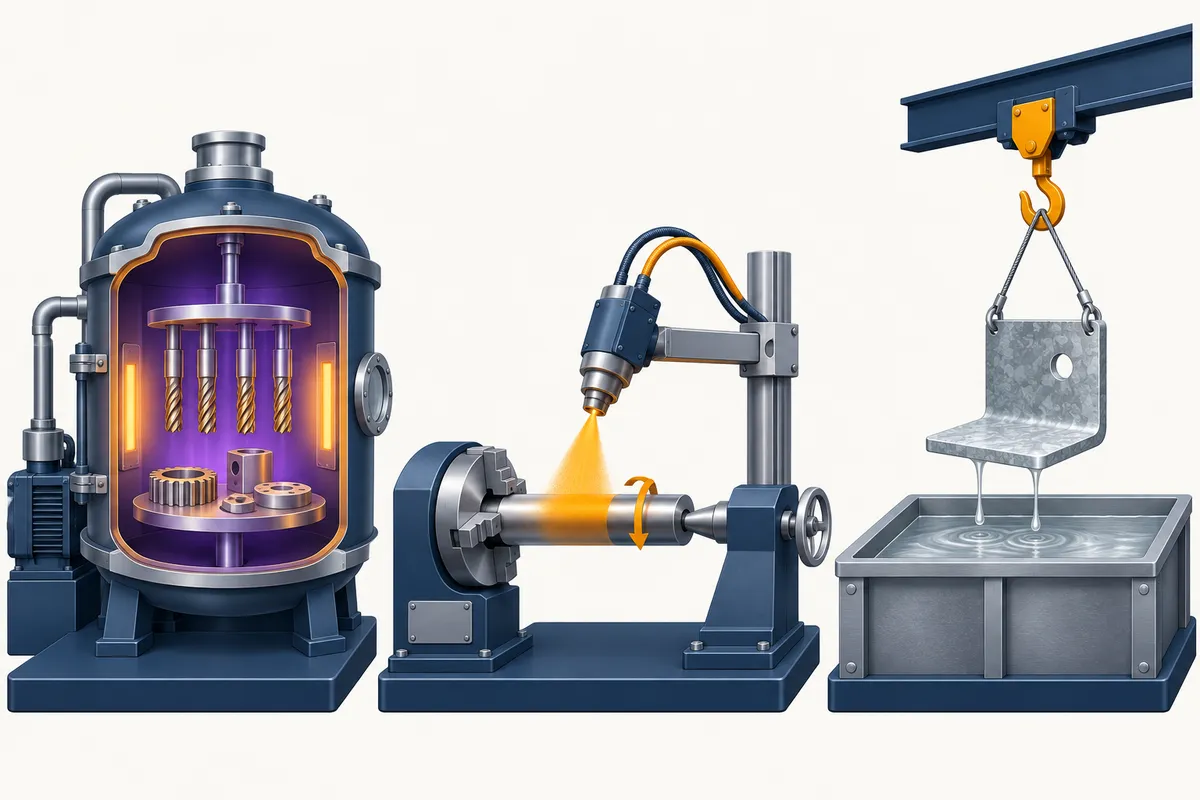
Some coatings go far beyond paint. A vacuum machine can lay a hard film a few thousandths of a millimetre thick, giving a watch a gold colour or a part a slippery, wear-resistant skin; a hot spray gun can blast molten metal or ceramic onto a worn shaft to rebuild it; and steel frames can be dipped in molten zinc to keep rust away for decades. Each adds a different thickness, which the machined sizes must allow for.
What it is
Beyond plating and paint (157, 158), four coatings often appear. PVD (physical vapour deposition) lays a hard film a few micrometres thick in a vacuum chamber: decorative gold and black on watch cases, taps and handles, and wear coatings such as DLC (diamond-like carbon) on sliding parts; it barely changes size. Thermal spray (热喷涂) melts powder or wire in a flame, plasma or high-velocity oxy-fuel (HVOF) jet and blasts it onto the part, building tenths of a millimetre or more of metal, carbide or ceramic against wear, heat or corrosion, or to rebuild worn shafts that are then ground to size. Hot-dip galvanizing (热浸锌) dips fabricated steel in molten zinc at about 450 °C, leaving a thick layer, typically several tens of micrometres; hollow sections need vent and drain holes, thin parts may warp, and nuts are tapped oversize. Zinc flake coatings (Dacromet, Geomet, 达克罗) are thin zinc and aluminium flake layers dip-spun onto bolts, without the hydrogen embrittlement risk of electroplating; early Dacromet contained hexavalent chromium, and chrome-free versions have largely replaced it.
Why it matters for products
Each is a finish catalogue entry with its own thickness effect on fits, masking rules, outside vendor and lead time.
Learn first
Making a part like this? Plan the process and estimate costs in Workspace.