



Cylindrical grinding: external, internal and centreless
外圆磨、内圆磨与无心磨
In plain words
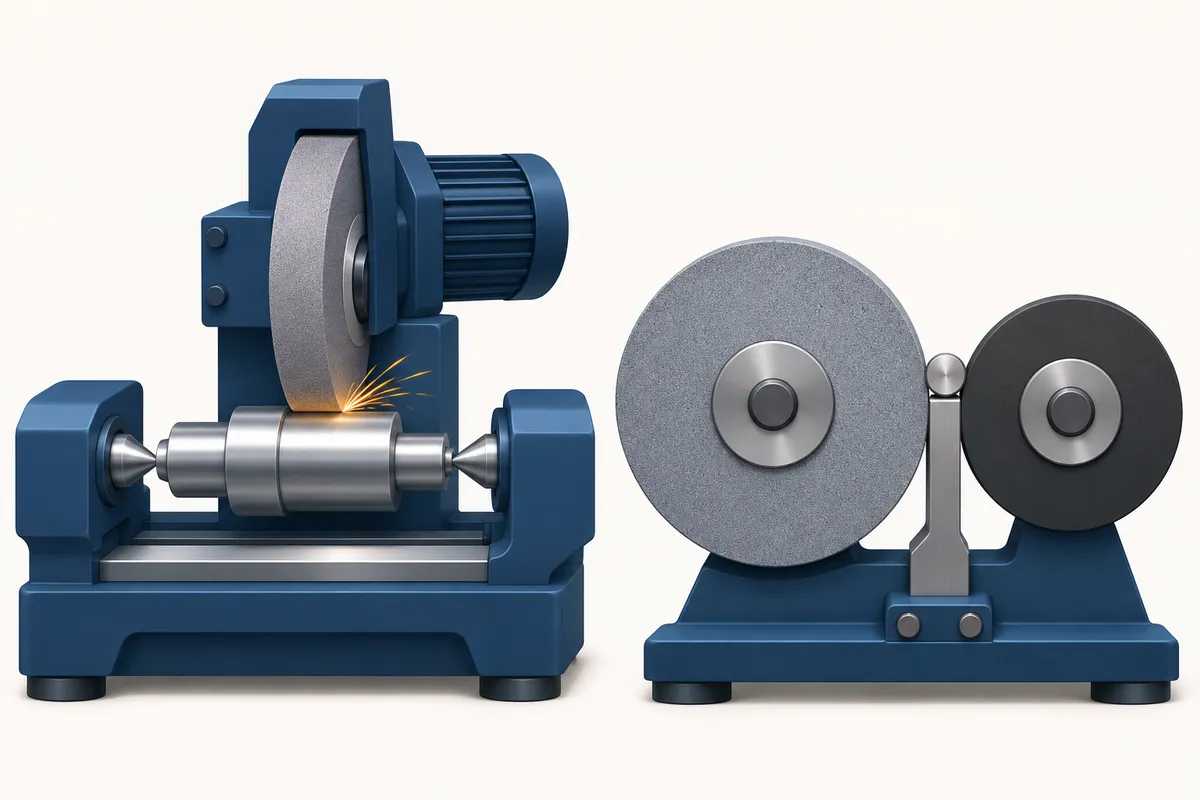
The round part turns slowly while a fast abrasive wheel shaves off a few thousandths of a millimetre, like sharpening a pencil on very fine sandpaper. It leaves a shaft exactly the right size and smooth as glass, even after it has been hardened.
What it is
Round parts are ground while they turn. External grinding holds the part between centres or in a chuck and either traverses the wheel along it or plunges a wheel as wide as the feature, for shaft diameters, shoulders and bearing seats. Internal grinding runs a small wheel on a fast spindle inside a bore. Centreless grinding has no centres: the part rests on a blade between the grinding wheel and a slower regulating wheel, which sets how fast it turns and, tilted slightly, feeds it through, for pins, rollers and bar in large numbers. Diameters hold to a few micrometres with Ra of about 0.2 to 0.8 µm. The turned part leaves a grinding allowance of a few tenths of a millimetre on the diameter, and a small groove at each shoulder lets the wheel run out.
Why it matters for products
Bearing seats and other tight, smooth diameters on a turned part, IT6 or better, imply a grinding operation after turning and usually after heat treatment; time follows the ground length, the allowance and the number of diameters, and centreless work has almost no setup per part.
Learn first
Opens the way to
Making a part like this? Plan the process and estimate costs in Workspace.